 +1 440 565 7123
 +44 20 7259 2477
Succession Planning and Succession Management


The real prize for investing in strategic talent management is flawless succession which drives organizational success.
Learn from more than 250 hours of Global 25 succession review experience.
Sometimes succession planning disappoints or fails to meet expectations. This happens most often when succession planning is delivered in isolation. Simply putting names against plans is not succession planning. While ample coverage may bolster confidence in succession plans, this confidence quickly erodes when facing a succession decision and suddenly, no one on the designated succession plan is deemed to be a viable successor. This results in a scramble to name a closest fit successor — often with mediocre results. While succession plans are often blamed, the real problem is not the succession planning tool, but the inadequacy or absence of an underlying mechanism to identify and develop a robust pipeline of succession candidates to populate these succession plans.
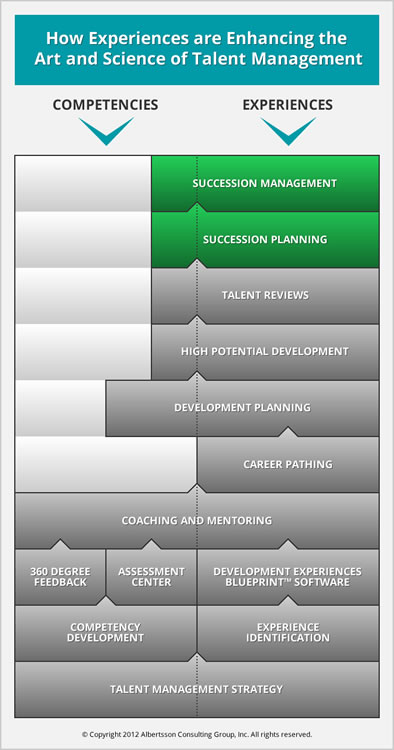
Succession planning and strategic succession management are most powerful when built upon an integrated foundation of talent management tools, programs and processes that identify, develop, calibrate, and accelerate the highest potential talent, and thereby, build a robust pool of best fit, developmental stretch and pipeline succession candidates for each succession plan within an organization. Underlying talent management tools, programs and processes include 360 degree feedback, assessment or development centers, coaching and mentoring, experience-based career pathing, development planning, high potential development programs, and talent reviews, amongst others.
Most importantly, an organization can transform their succession planning and strategic succession management by integrating experiences into the process. This involves the identification of the experiences required to drive success within an organization. Amongst those experiences, the identification of which experiences are required for success in specific succession positions. This information enables an organization to confirm that best fit succession candidates have those required experiences, developmental stretch candidates have most of those required experiences (providing an opportunity for development), and pipeline candidates have a clear development plan to acquire those required experiences (so that over time, they can credibly be designated developmental stretch or perhaps, best fit candidates).
Building on recognized best practice experience and more than 250 hours of Global 25 succession review experience, we will work in partnership to strengthen or build an integrated succession planning and strategic succession management process to build the bench that your organization needs to drive success and deliver on the business strategy.